
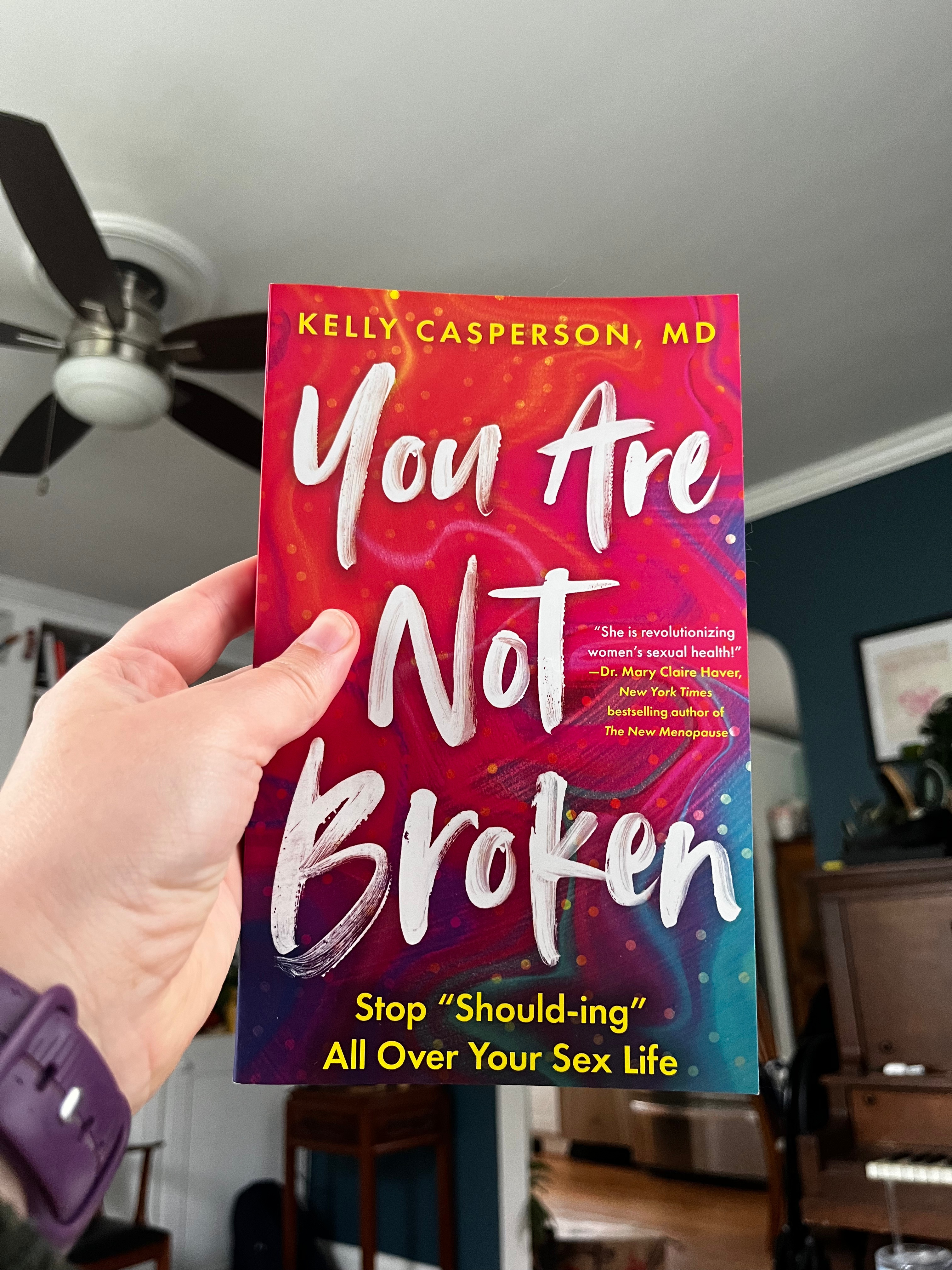
I am a big book girlie.
If you follow me on socials, you have probably seen my series: Booktok girlie’s guide to pain free sex, born out of my love of fantasy/romance/sci fi/literary fiction. I have also been making a point to dive deeper into books that I can put into a library for patients. My goal is to cover 1 either educational/self help or topically relevant book for me to review over here on the blog, that may help you in your pelvic health journey. We are starting things off with a heavy hitter.
You Are Not Broken by Dr. Kelly Casperson is a beautiful mix of medicine with real world application; a marriage of Dr. Casperson’s background both as a urologist and a life coach. The book focuses mostly on the female experience with sex. BUT, this book is good for everyone! Whether you are a woman or you love one, the information in this book is helpful for all.

Why is she so focused on the female experience? About 41% of women across the world experience sexual dysfunction before menopause.1 That number jumps up after menopause, ranging from 50-70%.2,3 Sexual dysfunction is almost a given when it comes to the female sexual experience and she is acting as a major change maker in this space. So what does she cover?
In part one she discusses the fact that there is so much baggage that comes with female sexuality. Add to that the fact that there is so little education and research about the female sexual experience and we have a big issue on a societal level. She dives into the impacts of the years and years of mixed messaging women receive – you should want to have sex (if you don’t you’re a prude), but not too much (that would make you a sl*t) and other fun, unobtainable dichotomies that often affect someone’s view of their sexuality. She also discusses how we commonly think that sex only ever involves a penis in a vagina and that this should always result in an orgasm for everyone. She puts that thought to bed with this great quote from chapter 1:
“While men tend to orgasm three to five minutes after vaginal penetration… women only EVER orgasm 20 to 30 percent of the time with PIV sex, and certainly not in under 5 minutes.”
Let that sink in. How is sex portrayed in the media? How has that affected your view of your sexual encounters? How does this knowledge change things for you?
In the second portion of the book, takes the time to go through the anatomy and physiology of the male and the female genitalia, as well as their path from arousal to orgasm. She also touches on hormones and their role, how things can change over the course of someone’s life (all the way from puberty to post-menopause), as well as how birth control can impact your activities. She even dives into the neurotransmitters in your brain that are responsible for achieving pleasure. For someone like me, who received years of anatomy/physiology education in school, but didn’t get any sex ed (other a 20 minute video on abstinence in high school), this was the much more thorough explanation that should have been given from day one.
In the third part, she focuses on the psychological factors that can effect sexual interactions. Big surprise here, communication is key. She harps on the fact that this is communication with your partner and with yourself. She also touches on medications for low desire, but points out that there are so many factors that play into desire. Her point is, there is not a “one size fits all” treatment for sexual dysfunction. This section is a great general overview and if you find yourself wanting more on this topic, Come As You Are by Emily Nagoski fills in the details (more on that in a future post). I appreciate her blend of medical knowledge with her life coaching experience. It serves as a great entry point for a lot of people and helps them really understand their body, where Emily Nagoski’s books really help you understand how the brain is involved.

This book has earned a space in my clinic’s library for it’s ability to pack a ton of education into such a concise, relatable, and easy to read format. This book is for you if you want to learn more about your body, or if you or a loved one are struggling to be intimate.
I’ll leave you with one final quote from the final chapter:
“Good sex isn’t an accident. It doesn’t happen TO YOU, it happens BECAUSE of you. This is a lifelong practice. No one is so good at sex that they can’t get better.”
-Naomi
References:
- McCool ME, Zuelke A, Theurich MA, Knuettel H, Ricci C, Apfelbacher C. Prevalence of female sexual dysfunction among premenopausal women: a systematic review and meta-analysis of observational studies. Sexual Medicine Reviews. 2016;4:197–212.
- Tavoli, A., Tavoli, Z., Effatpanah, M. et al. Prevalence and associated risk factors for sexual dysfunction among postmenopausal women: a study from Iran. womens midlife health 7, 10 (2021). https://doi.org/10.1186/s40695-021-00069-0
- Magdalena Dąbrowska-Galas, Jolanta Dąbrowska, Bogdan Michalski, Sexual Dysfunction in Menopausal Women, Sexual Medicine, Volume 7, Issue 4, December 2019, Pages 472–479, https://doi.org/10.1016/j.esxm.2019.06.010
Leave a Reply