
Ever been walking around during pregnancy and suddenly you get a jolt of pain right on your pubic bone? Noticed more back pain or pain at the base of your spine as your pregnancy progresses?
These symptoms all fit into the classification of pelvic girdle pain in pregnancy, which is just a very general way of saying where their pain exists without saying what the contributing factors might be. Where is the pelvic girdle?

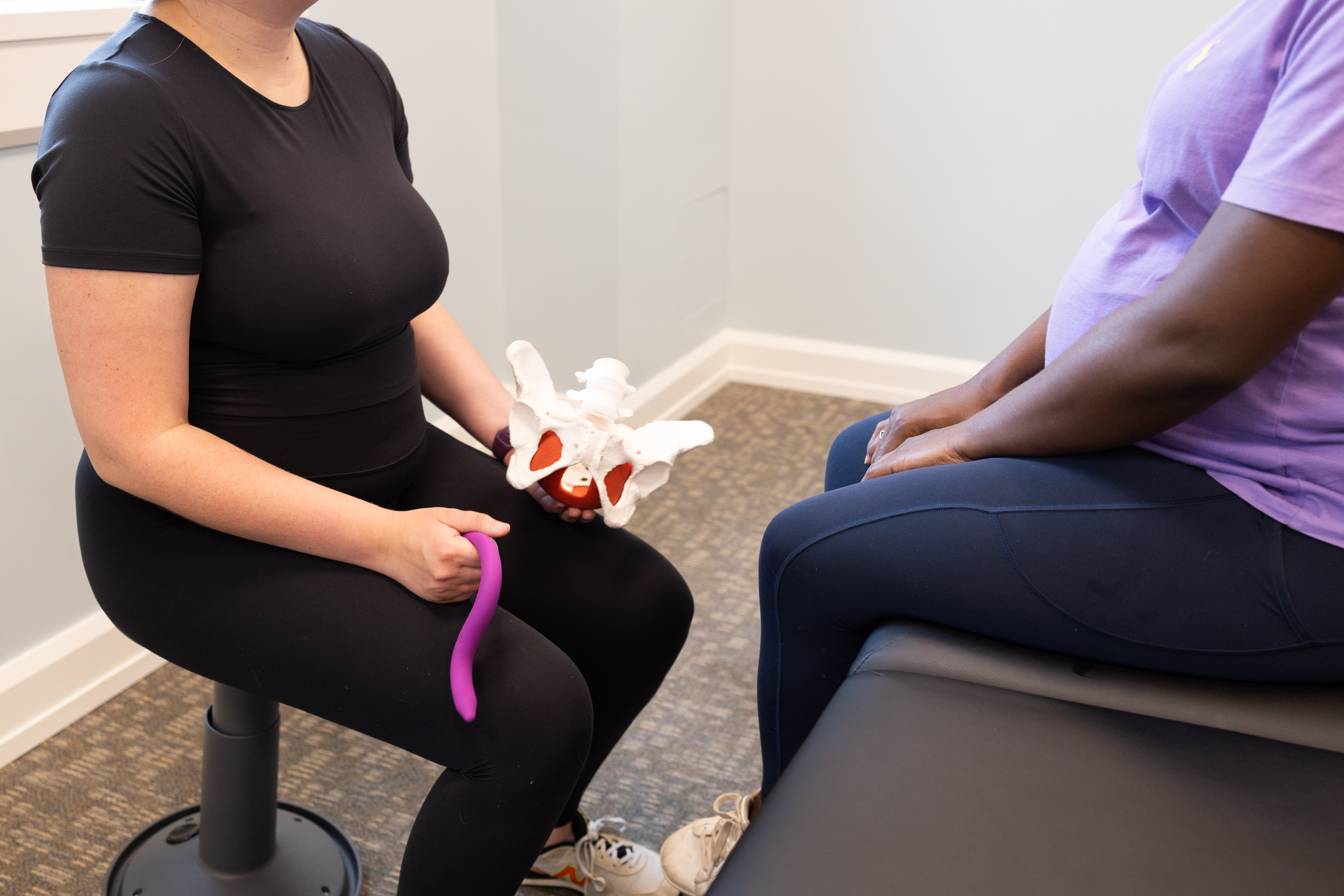
We find the pelvic girdle at the base of the spine. It’s a combination of a few different bones (ilium, pubis, sacrum, coccyx, and ischium) that together make up what we call the pelvis or pelvic girdle. It’s what connects our legs to our spine. It helps transfer force that our body takes on every time our feet hit the floor, and distributes it.
There are so many muscles that attach here! Just to name a few: the glutes (max, med, min), the quads, the hamstrings, the piriformis, the pelvic floor, the abs (all of them!), the spinal musculature, the lats, and so many more. The notable joints here are at the front of the pelvis (the pubic symphysis) and the sacroiliac joint, which connects the sacrum (the base of the spine) to the ilium (the big wing shaped bone). All of these joints are VERY stable. They are designed to not move very much.
The pelvis relies on two main features to help with transferring the force from your legs and dissipate it. The first is called form closure; this is the fact that the pelvic girdle is such a tightly fit ring that allows for minimal movement, making it strong and stable. The second is called force closure; the muscles, ligaments, and fascia around these joints help to maximize the joint’s function by locking the joint and improving stability.
What happens during pregnancy? A couple things. The thing that gets the most blame is hormones. Relaxin works to make you more stretchy to help get your body ready to have a baby. This laxity occurs across all forms of connective tissue (which effects everything!), including all of those incredible ligaments pictured above, which allows for a slight increase in mobility in the joints that make up the pelvic girdle. There are however, recently published papers showing that the increase in relaxin does not necessarily related to increase pain levels. Pain is an output of the brain, so higher hormone levels do not automatically mean more pain.
The research shows that the pubic symphysis (what we commonly call the pubic bone) widens on average 7 mm as early as 8-10 weeks gestation. Pain is more likely to be present if the pubic symphysis widens greater than 10 mm or one side shifts vertically 5 mm. However, this is not a linear correlation, meaning as the pubic symphysis gets wider, the pain does not always get worse. This is similar to what we see in the low back pain research, which shows that presence of anatomical changes (like a herniated disc) does not automatically mean the person is in pain, but that’s a topic for another day.

The second thing that likely contributes is the lengthening of the abdominal muscles to accommodate the growing baby. These muscles act like a corset around the spine and help to create a strong stable system to help you move, lift, or carry items. Muscles are really good at functioning in the middle of their range. As these muscles stretch, it can make it harder for them to do their jobs as efficiently and effectively, often leading to our brain calling on other muscles to try and help stabilize the system. This can add to people’s symptoms, since these muscles are often not as effective that this job, or are not coordinating well with the abs to properly stabilize. A common example is, the inner thighs often tighten up to try and stabilize the pelvis and provide support. They are often just sitting contracted and not coordinating with the abs and back muscles.
So what do we do about it? We work on improving the mobility and control of those tight muscles, continue to strengthen the core, and work on core and lower body muscle coordination.
I’ve already given you a ton of jargon today, so we’ll save that discussion for another day.
Sound like you? Pelvic PT during pregnancy is safe and effective at helping to manage body pains that you may be experiencing. Email me to set up a discovery call today!
-Naomi
Want to read more? Check out the clinical practice guideline here:
Clinton, Susan C. PT, DScPT, OCS, WCS, FAAOMPT1; Newell, Alaina PT, DPT, WCS, CLT-LANA2; Downey, Patricia A. PT, PhD, DPT3; Ferreira, Kimberly PT, PhD, MSPT4. Pelvic Girdle Pain in the Antepartum Population: Physical Therapy Clinical Practice Guidelines Linked to the International Classification of Functioning, Disability, and Health From the Section on Women’s Health and the Orthopaedic Section of the American Physical Therapy Association. Journal of Women’s Health Physical Therapy 41(2):p 102-125, May 2017. | DOI: 10.1097/JWH.0000000000000081
Leave a Reply