
This Saturday Baltimore will host the 25th annual Baltimore Running Festival (so avoid the city if you can!). Myself, my husband, and thousands of other runners will be participating this year.
Maybe, like me you’re new to running. Maybe you’re using a race this marathon season to help you get back into exercise after a major life change, like a hysterectomy or having a baby. Good for you! That is so awesome!
Sometimes little issues start to pop up. Your hip is bothering you while you run. You start to have some calf pain. And then as you lengthen your runs, you start dealing with incontinence.
For some, leakage may pop up during their run.
Why is that? There are 2 elements to look at.

The first is intra-abdominal pressure. What is that? Well, simply put it is the level of pressure inside your abdomen. This is influenced by the amount of stuff sitting inside your abdomen and how small your trunk is (read how tight or contracted your muscles are). Our body uses our abs to help control this pressure and use it to our advantage to stabilize our spine. Sometimes our musculature is not equipped to handle that pressure and fails.
Talking with my mechanical engineer husband, I learned that you are unable to deform water in a pressurized container. Very interesting, and very applicable to this situation.
Think about a can of your favorite drink. The top, bottom, and sides are all pressurized to keep the liquid in the can (not to mention that it’s nicely sealed up). The liquid in the can is also applying pressure to the sides of the can. If you remove the side from the can, all of the liquid is going to spill out because pressure has equalized to atmospheric pressure and, more importantly, there is no longer anything holding the liquid in on that side.
A strong, coordinated core is like the intact can. The diaphragm (top), back muscles and core (sides), and pelvic floor (bottom) all help to pressurize the spine and make it strong. This helps control spinal movement and take some pressure off of the discs, ligaments, and joints in your spine.
A weak and uncoordinated core is like weakening the side of the can. The system is not robust enough to coordinate and control all of the pressure it needs to manage. This results in some form of leakage (every cough/sneeze, laughing hard, lifting any weight, running any distance, one jump, hernia, herniated disc etc).

The second element is similar – the body’s ability to manage the force in the rest of the body.
Did you know that the muscles of your lower body have to take on forces that are sometimes, double, triple, quadruple, etc your own body weight? Your achilles tendon has to take on 6-7x your body weight. Your patellar tendon (what attaches your quad to the bone just below your knee) has to take on 5.5x your body weight. Your gluteus medius (found on the side of your hip) has to take on 4x your body weight.
If one or more of these muscle groups aren’t able to take on that amount of force and help to dissipate that force as it moves farther up the chain, your pelvic floor and core may have to take on more load.
You may be able to feel what the solution is. Wanna guess?

Did you guess strength training? Great job. That’s one element. Lifting heavy weights is going to help your body’s tolerance for those peak force levels that your tendons and muscles are having to absorb. It’s also going to build your core’s tolerance for managing intra-abdominal pressure.
Backing that up with core strengthening beyond the traditional “anti” movements – bird dogs and dead bugs. I’m talking working up to rotational movements, crunches and sit ups, and working in extreme ranges of motion in order to build up your core strength and it’s ability to manage intra-abdominal pressure.
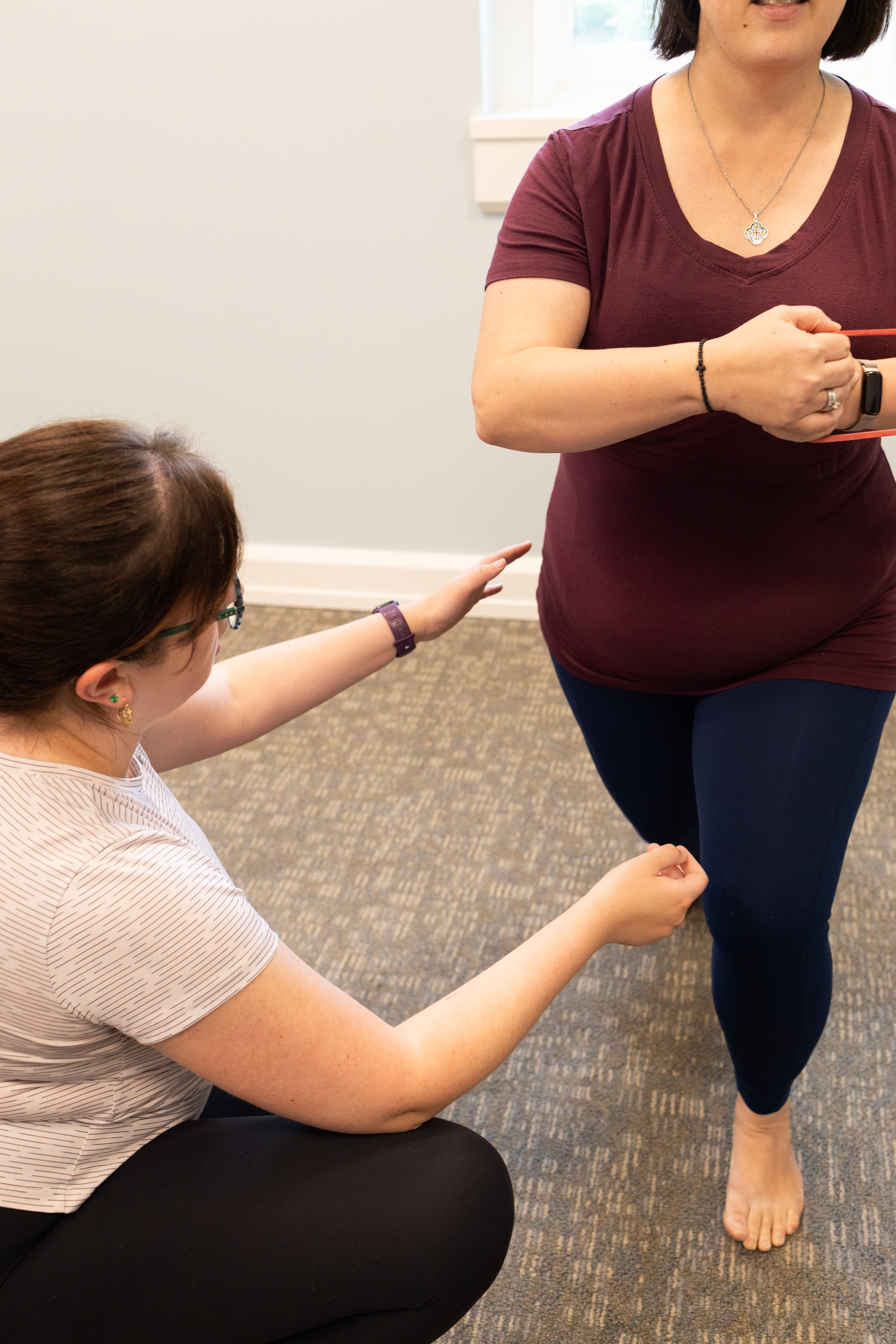
The other (maybe) less obvious piece, is having someone analyze your running gait. It’s important for a good PT to see the strategies your brain uses to absorb the force it receives from the ground and see if there are things to clean up. This means looking at the foot, the ankle, the knee, and the hip. Not just the pelvis.
If your pelvic floor PT is only looking at your pelvic floor and you’re not getting better, it’s time to ask for a better approach.
Want a PT who understands whole body care? Shoot me an email to get set up with a discovery call to see how PT may be right for you.
Happy Running!
-Naomi


Leave a Reply